

REFERENCE CAPTURE

Two-stage op-amp

seed 0A fresh design on every run
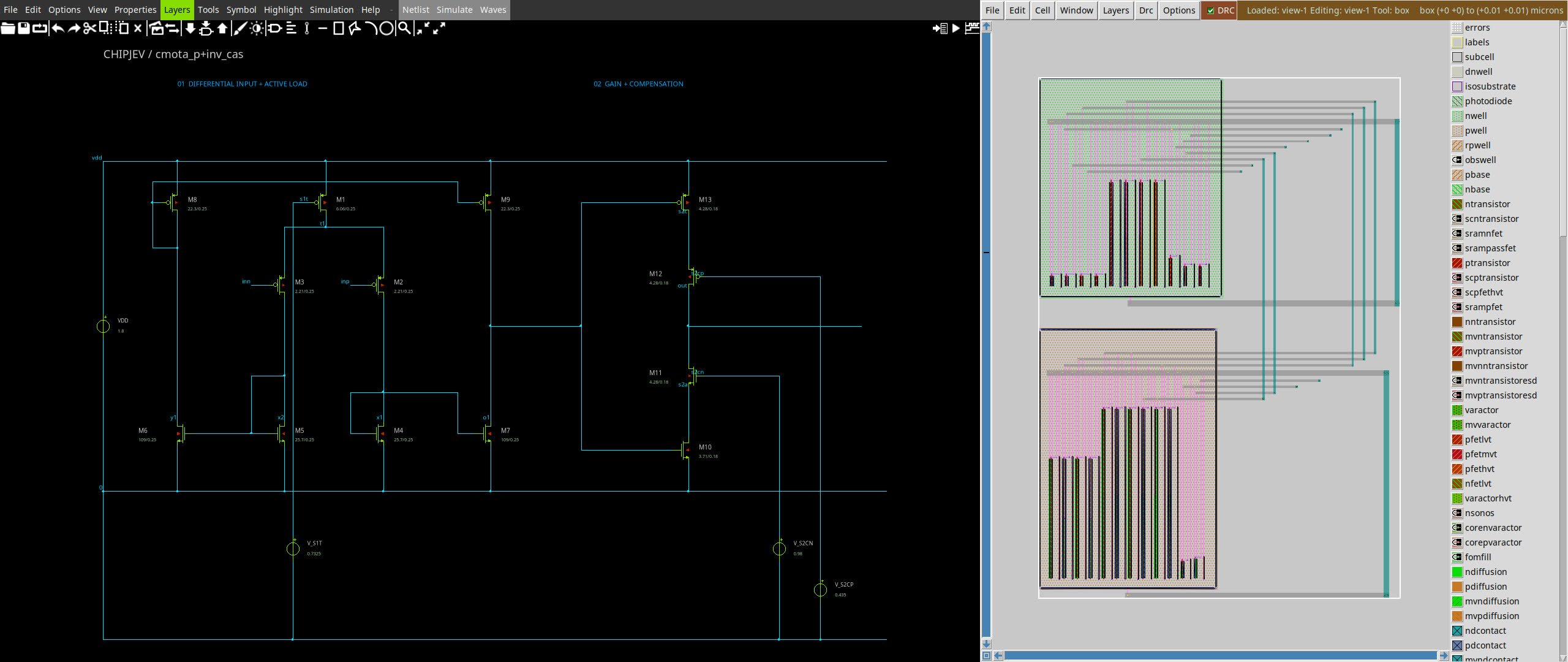
xschemReference schematic
Reference capture: connected SKY130 op-amp in the native xschem editor

The design loop's best design appears here.

MagicReference layout
Reference capture: the matching SKY130 physical layout in the native Magic editor

Placement, routing and acceptance update with each layout.

REAL TOOLS. REAL CONNECTIONS.

Pick or write a prompt and start to watch the run live.

Design-loop convergence

Distance to the spec Best signed-off goal

Waiting for the design loop

The working and sign-off fidelities appear after step 2

Appears after sign-off

Built from the signed-off records of this run

Watch the run ChipLaya reads the sentence, the engine searches and signs off the circuit, and xschem and Magic draw it: DRC, LVS, extraction and post-layout simulation check the layout.

View-only · No installation

Requirements, sign-off and layout

Targets, sign-off values and margins appear here.

Every requirement of the prompt, then the goal and the other metrics of the best design
MeasurementTargetSign-offProven at
Start a design to see its requirements.

How ChipLaya read the prompt

Every answer, extracted number and default appears after step 1.

Architectures considered

ArmPriorStatusScreenReason
The plan appears after step 2.

Design loop

The stop reason, first feasible design and effort per fidelity appear when the loop ends.

Plots and measurements come from the current run.

BEHIND THE DEMO

Fast decisions.
Measured circuits.

ChipJev v2 turns one sentence into a typed spec and searches until a design passes sign-off.

Explore the research and results
01 / READ

One sentence becomes a typed spec.

A deterministic extractor reads every number and unit in English or Chinese. No language model writes numbers. ChipLaya v1.0.1 answers only closed questions: the family and the goal; the architecture and its sub-blocks; what each number specifies, and whether it is a lower or upper limit.

ChipLaya is our decision model: Laya by Convai Innovations, run through a PyTorch port of Laya-MLX and fine-tuned for circuit design (model repository ↗). The op-amp questions use its pinned tensors and the new questions use the v2 agent tensors. Every answer is combined with a rule prior, and the spec lists every default it filled in.

02 / DESIGN

Search where the physics allows.

Every buildable architecture becomes an arm, and analytic models screen out provably infeasible ones. An asynchronous engine runs up to 12 ngspice workers with warm starts from analytic optima; Gaussian-process proposals inside trust regions; a fidelity ladder that promotes promising designs from cheap working benches to sign-off (corners, Monte Carlo, full ADC records); repairs ranked by ChipLaya; successive halving across arms; scouting of other structures once a feasible design exists; and stop rules for convergence and budget.

ADCs are designed hierarchically: comparator and sampler blocks are searched against budgets derived from the ADC spec.

03 / VERIFY

Real tools, honest results.

A design counts only when it passes at its sign-off fidelity. Every family then shows its design as xschem schematics, checked against the netlist the engine simulated, and as Magic layouts with DRC, LVS, extraction and post-layout simulation. Op-amps run the ChipLaya-guided Magic layout loop with RC extraction and post-layout ngspice. Comparators and sampling switches get one Magic cell, whose extracted netlist is simulated again at tt; a design that misses a limit there is reported as "layout failed". SAR and flash ADCs are drawn block by block (comparator, sampler, CDAC and SAR logic, or the comparator row and the resistor ladder) and assembled; DRC and LVS check the whole hierarchy, and the s3 conversion bench runs again on the extracted netlist. The flash encoder is not drawn: the signed-off netlist decodes the thermometer code in Python (behavioural), so the comparator outputs are the layout's ports.

The experimental LDO, active-filter, DAC and integer-N ring PLL examples use transistor netlists, xschem, Magic DRC, Netgen LVS and extracted-circuit simulation. References, bias and loads are external. PLL lock is checked in the complete transistor loop; random jitter, phase noise and mismatch yield are not measured. A missing measurement cannot satisfy a requested limit.

When the design loop stops at its budget without a qualified design, ChipJev still draws, checks and extracts the least-violating one and says where it stands. A run stops at 30 minutes at most; most take 1–8 minutes. You can download the spec, decisions, engine trace, netlists, xschem sheets, testbenches and layouts of the current run.

Inspect the live pipeline ↗
Op-amp12/121.1 s median to first sign-off (9 simulated designs)
Comparator8/818 s median to first sign-off
Sampling switch2/234 s median to first sign-off
ADC3/477 s median to first sign-off

Frozen study of the prompt agent (experiments/prompt-agent, 2026-09-27): 186 runs on 6 CPU workers. The counts are runs that reached a sign-off-feasible design. One 10-bit SAR specification was not met within 6,000 CPU-seconds. Against the legacy batch loop, the agent needed at least 1.5× fewer simulated designs on op-amps and comparators (pre-registered test H2, Holm-adjusted p = 3×10⁻⁵); the other pre-registered hypotheses were not supported. Iteration 2, the engine this demo runs, reaches the first sign-off-feasible design as fast (paired median ratio 0.98–1.02). It still stops early on some optimization goals: its final values trail the best run of any method by a normalized regret of 0.40 on op-amps and 0.50 on comparators. With the v2 tensors, ChipLaya read the family, goal and architecture of every English and Chinese study prompt; its lowest score on held-out paraphrases was 0.88 (Chinese structure decisions). The demo runs with more workers and a GPU, so its times differ. Read the study report and the iteration 2 report.

START FROM AN EXAMPLE

What should ChipJev design?

Choosing an example puts its sentence in the prompt box, where you can edit it or write a different one. Every prompt runs the prompt agent live. ChipLaya reads the sentence, and the engine searches, simulates and signs off the circuit with ngspice while xschem shows the best design. Every family then continues into Magic layout with DRC, LVS, extraction and post-layout simulation; the flash ADC's encoder is behavioural and not drawn. A run stops at 30 minutes at most. Established examples show their verified seed. The new LDO, filter, DAC and PLL examples are experimental; their results may fail a requirement or physical check. Edited prompts have no verified seed.